Building weekend liquidations for tokenized stocks, tested on 35 real market closures
11 min read
liqfacility lines up committed buyers before the market closes, sells only what a loan needs, and clears the rest in one auction at reopening. In a benchmark built on real market closures, it cut borrowers' liquidation costs by about 60%.
You can now buy a token that tracks Tesla, hold it in your wallet on a Sunday, and borrow dollars against it. The loan never sleeps: interest accrues every second, and the lender checks every second whether you still owe less than your collateral is worth.
The stock market sleeps a lot. It is fully open about 33 hours a week, and closed outright from Friday evening to Sunday evening.
So here is a question nobody had to answer before tokenized stocks: if the price falls while the market is closed, and your loan needs rescuing, who buys your stock?
Today, often nobody. This post explains why from scratch, describes a fix I built, and shows what happened when I tested it on 35 real market closures.
Part 1: The problem
Two clocks
A tokenized stock is a token backed by a real share. An issuer holds the share and gives you a token you can move like any crypto asset. Lending markets such as Aave, Morpho and Kamino now accept these tokens as collateral.
The token trades around the clock. The share behind it does not. Here is the US stock market’s week:
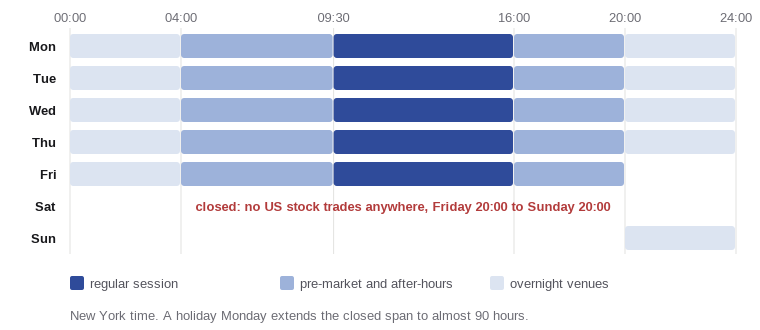
Prices that matter, the ones big funds trade at, come from the regular session. Outside it, prices exist, but they are thin, and on the weekend they don’t exist at all.
How a crypto loan stays safe
Suppose you hold $10,000 of tokenized stock and borrow $6,000 against it. The ratio of what you owe to what your collateral is worth is called the loan-to-value, or LTV. Here it is 60%.
Every lending market sets a limit. Above it, your loan can be liquidated: anyone may repay part of your debt and take some of your collateral in exchange, at a discount. That discount is their reward, called the liquidation bonus. Bots that do this for a living are called liquidators.
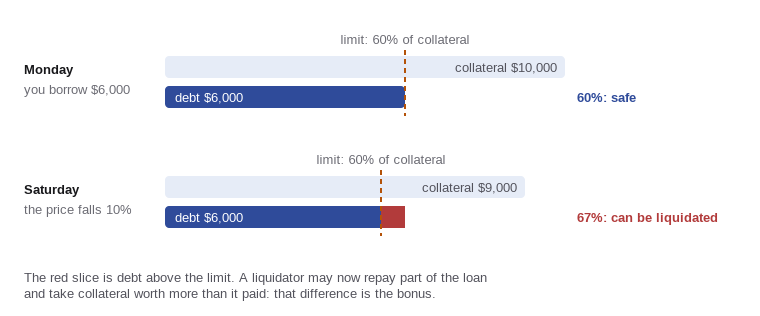
This works beautifully for crypto collateral like ETH, because a liquidator can sell what it seizes immediately, any hour of any day. The whole design quietly assumes that.
What breaks on a Saturday
Three things go wrong when the collateral is a stock and the stock market is shut.
The price. There is no official stock price on Saturday. Some lenders freeze the last Friday price until Sunday night, so they cannot see a fall happening. Others estimate a weekend price from perpetual futures, contracts that track the stock and trade around the clock. Either way, it is an estimate.
The exit. A liquidator that seizes stock tokens on a Saturday has to sell them somewhere, and the only buyers are thin weekend markets. I measured this with real order books for tokenized Nvidia:
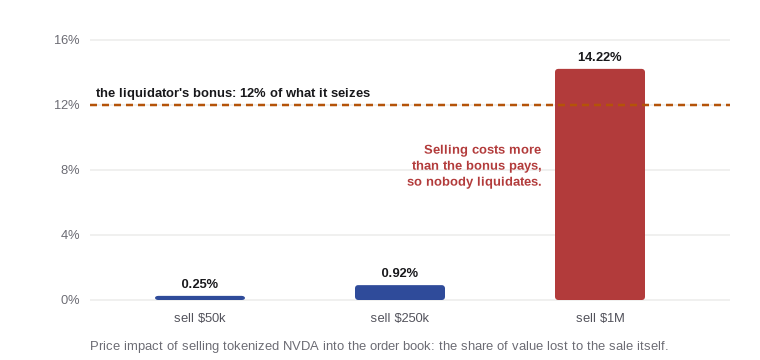
The bonus. With a 60% limit, a liquidator’s bonus is about 12% of what it seizes. If selling the seized stock costs more than that, liquidating loses money, so the liquidator walks away. The loan sits above its limit, and the risk lands on the lender.
Lenders know this, which is why stock-token loans are capped low, around 60%. That is the real cost of the clock problem: every borrower can borrow less, every day of the week, because of what might happen on a weekend.
Part 2: The idea
Line up the buyers before the weekend
The problem is not really the price. It is that nobody has promised to buy. So make someone promise, in advance.
Before Friday’s close, market makers, firms that buy and sell professionally, post commitments: “I will buy up to this much Tesla token this weekend, at 2% below the reference price.” Their cash is locked in escrow, and the promise cannot be withdrawn once the weekend starts. That last part matters. Ordinary buy orders get pulled exactly when prices drop, which is when they are needed.
Market makers are paid for this. They earn a small fee for standing ready, whether or not they are used, plus the discount when they buy. They can protect themselves from further falls by selling the stock’s perpetual future at the same moment.
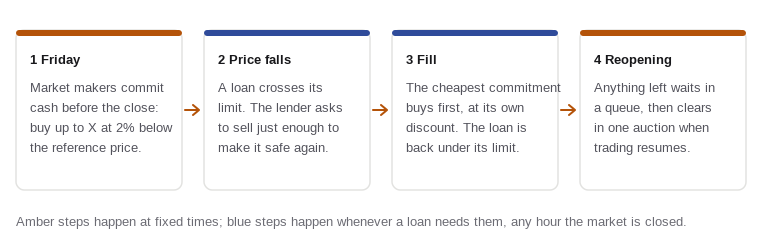
If commitments run out, remaining requests join a queue. Borrowers in the queue can still add collateral or repay to get out of it. When trading resumes, Sunday at 20:00 or the Monday open, the queue clears in one auction where everyone gets the same price. Stock exchanges do the same thing every morning: when you cannot trade continuously, you gather everyone and trade once.
Sell only what is needed
Liquidations today often repay the whole loan. That is harsh on a borrower who is barely over the limit.
The facility sells only enough collateral to bring the loan back to a safe level, five points below the limit. For a loan just over a 60% limit, that means repaying about a fifth of the debt instead of all of it.
Part 3: Does it work?
Testing on 35 real closures
I built the facility: a Go service, smart contracts, and an adapter tested against a copy of Morpho’s real contracts on the Base chain. Then I wrote a benchmark that replays real market closures, 12 weekends and 23 weeknights between October 2025 and November 2026, for five stocks: Tesla, Nvidia, Meta, Coinbase and MicroStrategy. Not every stock moved on every closure, so that makes 83 stock-by-closure runs, plus two synthetic crashes to stress the design.
Each closure runs six ways, with the same loans and the same prices: the facility, and five approaches lenders use today.
- Frozen price: hold Friday’s price, liquidate once prices resume.
- Partial sell: the same, but repay only enough to restore the loan.
- Wait for Monday: block liquidations until the market opens.
- Low cap: keep loan limits low and liquidate as normal.
- Always on: use a 24/7 price and liquidate any time, into thin weekend markets.
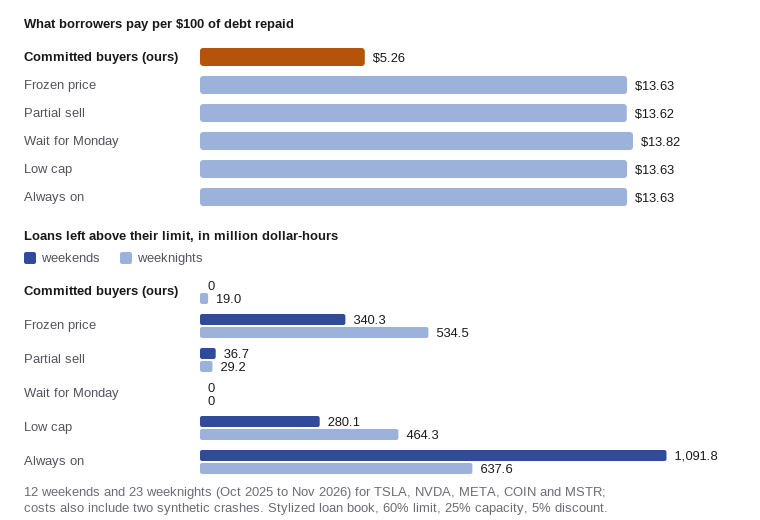
Two results stand out.
Borrowers paid about 60% less. Across every scenario in the run, for every $100 of debt repaid, borrowers lost $5.26 with the facility and between $13.62 and $13.82 with the other approaches. That is the reference setup: a 60% limit, commitments worth 25% of the collateral, and a 5% buyers’ discount, far smaller than today’s fixed bonus.
Loans were not left hanging. “Dollar-hours” measures risk left on the table: $1 million above its limit for 10 hours is 10 million dollar-hours. On weekends, the facility left none. On weeknights it left 19 million, against 535 million for frozen prices and 638 million for always on. All of it came from one night when Nvidia fell 13%: the facility filled six times, but four loans were still above their limit at the open. “Wait for Monday” also leaves none, but only by selling everything at the opening bell, which made it the most expensive approach for borrowers.
An honest note on losses: real history has been kind. Across all 390 combinations tested on real closures, lenders lost money in only three, all under “wait for Monday” at an 85% limit, and never more than about $52,000. The facility had none. The real question is not what happened, but what it would take to lend more safely.
The price of a higher limit
If a lender wants to raise its limit from 60% to 70% or 75%, how much cash must buyers commit? There is a simple formula for it.
The benchmark applies this to every loan in the book, at the market’s discount cap of 10%. For a 70% limit and a 15% drop, it says buyers must commit about 46% of the collateral.
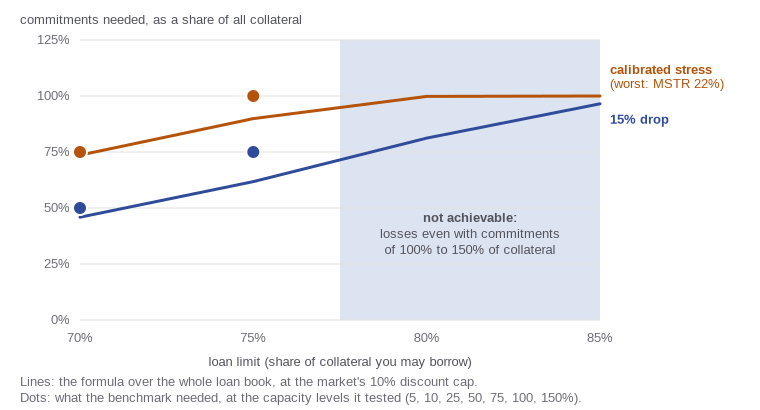
The benchmark lands on the next level up from the formula every time. To lend at 70%, buyers had to commit 50% of the collateral to survive a 15% drop, and 75% to survive each stock’s own stress level, which runs from 13% for Tesla to 22% for MicroStrategy, based on their worst historical moves. At 75%, those became 75% and 100%. At 80% and above, the benchmark still found losses even with commitments of 100% to 150% of the collateral, so those limits stay out of reach.
In every case that worked, buyers charging a 2% discount still made money, even after paying 1.5% to hedge, and borrowers paid about 2.1% including fees, against the 8% to 10% bonus today’s liquidations charge at those limits.
What this does not prove
- The loans are stylized. I modelled typical loan books rather than measuring real ones, so the dollar amounts compare approaches rather than describe a market.
- Weekend prices are estimated from perpetual futures, and exit costs come from a single snapshot of each order book.
- Market makers’ willingness is assumed. Whether they will commit capital at these prices is the question the benchmark cannot answer.
- Existing lenders limit it. On Morpho, once a loan is over Morpho’s own limit, a partial rescue can only release collateral through Morpho’s liquidation, which caps the buyers’ discount at Morpho’s bonus: 6% at an 80% limit. A rescue that repays the whole debt has no such cap. The full design works best with a lender that adopts it directly.
One lesson from building it: a review before publishing found the facility making no fills at all on eight holiday weekends. Commitments were capped at 72 hours, and holiday closures run almost 90. The fix was one number. The lesson is that in markets, the calendar is part of the system.
Epilogue
Stock exchanges solved this problem decades ago. When trading has to stop, they halt, gather buyers and sellers, and reopen with an auction. Tokenized stocks bring that old problem into a system that never stops, and most lending markets have not noticed yet.
The market can close. The promise to buy should not.
References and further reading
- Larry Harris, Trading and Exchanges: Market Microstructure for Practitioners, Oxford University Press, 2003. Chapters on dealers, call auctions and circuit breakers.
- Morpho, liquidation concepts: how on-chain liquidations and the liquidation bonus work.
- Multiliquid, capital provider documentation: committed capacity for tokenized fund redemptions, the model this design adapts.
- The full benchmark report, with every closure and every loan, will be published with the repository.